 Variety Partners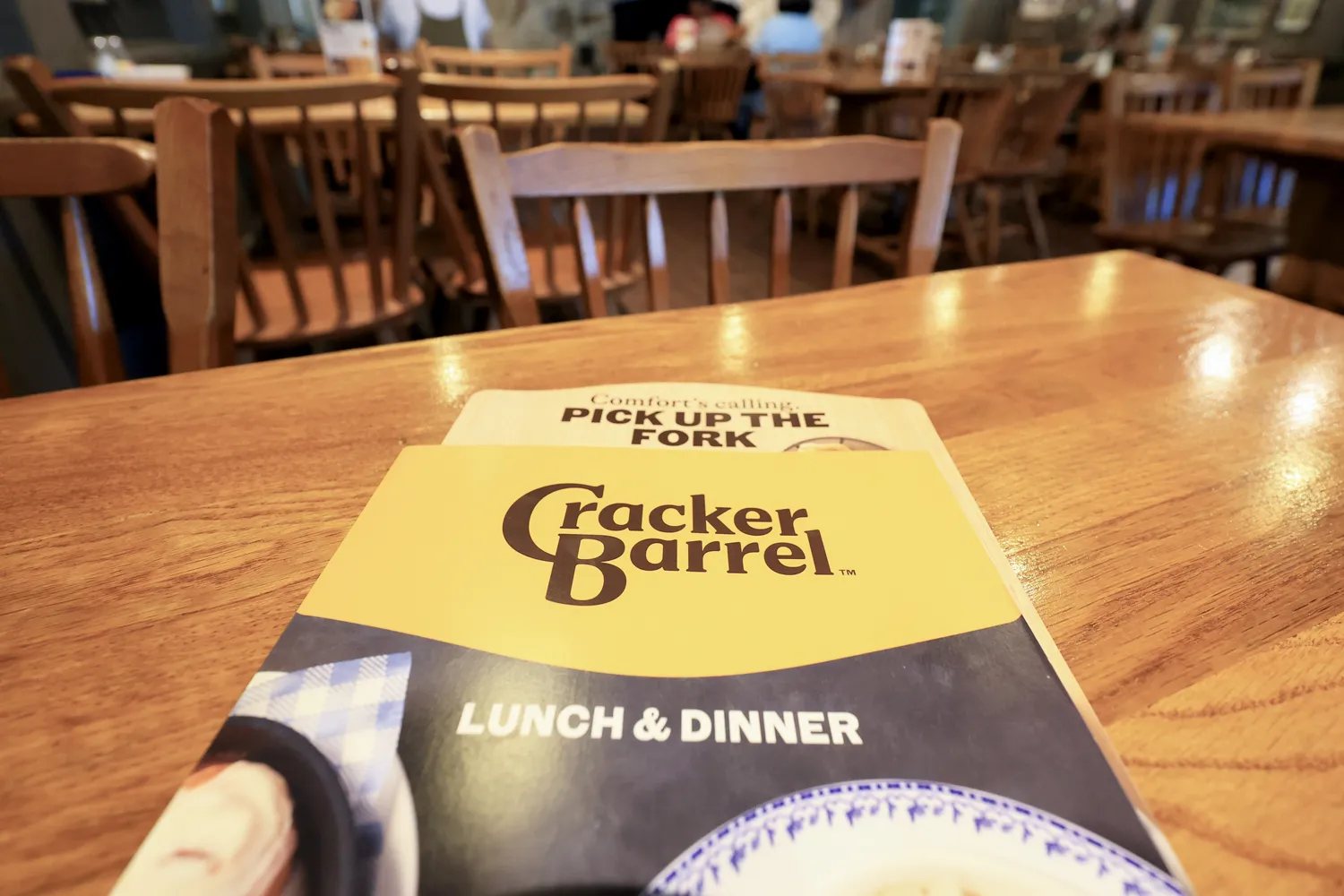
Start with the number, because the number is where the argument usually ends. In late August 2025, Cracker Barrel unveiled a new logo, and within days the company had shed roughly $100 million in market value. Not from a product recall. Not from a bad quarter or a lawsuit or a data breach. From a drawing. The old man was gone, and the market noticed.
The old man had a name. Uncle Herschel, the illustrated old-timer leaning against a barrel, had anchored the brand for decades, drawn originally by an artist named Bill Holley. The 2025 redesign, handled by an internal team, kept the gold-and-brown palette and a typeface close enough to the original that most people could not have told you what changed if you asked them cold. What changed was the man. They took him out and left the words behind.
The company reversed within days. It went back to the familiar logo, parted ways with the design firm involved, and, some months later, its CEO Julie Masino stepped down. The whole episode reads now like a compressed tutorial in a single idea, which is this: a brand does not belong to the company that owns it. It belongs to the people who love it. And they had not been asked.
A logo is not the brand
It is worth being precise about what a logo actually is, because the confusion at the center of this story is a confusion about that. A logo is a signal. It is the smallest possible unit of recognition, the thing that lets a driver on an interstate know, at seventy miles an hour, whether the next exit holds a warm room, a rocking chair, and a plate of biscuits. The logo is not the warmth. The logo points to the warmth. It is a door, not a house.
Cracker Barrel, founded in 1969, spent more than half a century filling that house. Every meal served under a fluorescent porch light, every checkerboard on the table, every road-trip memory of a family reunion off Interstate 40 went into the account. Uncle Herschel was not decoration on that account. He was the receipt. He told a customer, before a single word was read, that this was a place that had not changed, that would not change, that could be trusted to be exactly what it was the last time.
Equity is trust, and trust is slow
Brand equity is one of those phrases that gets emptied out by overuse, so let us refill it. Equity is the accumulated belief that lets a company charge more, wait longer, and survive mistakes. It is why you will drive past three unfamiliar restaurants to reach one you know. It is not on the balance sheet in any honest way, and yet the market priced it in real time the week the logo changed. A hundred million dollars is what the belief was worth, or at least what the threat to it was worth.
The thing about that kind of equity is that it is built slowly and spent fast. Fifty-six years to accumulate, one design review to endanger. That asymmetry is the whole lesson for anyone running a brand. You do not get to treat the most valuable thing you own as the most disposable thing on the slide. The people in the room who approved the new mark were, in effect, writing checks against an account they did not fully understand they held.
The backlash was a feature, not a bug
The backlash came fast and came loud. Part of it was nostalgia, the plain grief of watching an American icon get erased. Part of it was political, with critics reaching for the word 'woke' the way people reach for any available weapon. The politics are not the interesting part, and they are not the lesson. Set them aside. Underneath the noise was a signal any brand should want to hear, even at that volume: the customers believed the logo was theirs.
That is the tell. Nobody rallies to defend a mark they feel nothing about. Indifference does not trend. The fury was proof of ownership, and ownership is the asset. A brand that can anger its customers by changing is a brand that has customers who care whether it changes. The tragedy of the Cracker Barrel redesign is not that people were upset. It is that the company treated a demonstration of loyalty as a public relations problem to be managed rather than as the equity it was.
You can modernize. You cannot do it alone.
Here is the part that gets lost in the retellings, because the retellings enjoy the reversal too much. Standing still is not safe. It is its own slow risk. Cracker Barrel had real reasons to worry about looking dated, about aging with its core customer, about a younger diner who drives past the porch without a flicker of recognition. The instinct to modernize was not the error. Brands that refuse to evolve do not stay frozen in amber. They fade, one indifferent generation at a time.
The error was the method. The redesign was done to the audience rather than with them. Decades of accumulated trust were handed to an internal team and a whiteboard, and the people whose belief constituted the entire value of the mark were not in the room. You cannot modernize a brand you do not own alone, and no company fully owns a beloved brand. It holds it in trust. Permission is not a courtesy in this work. It is the mechanism.
How to change what people love
So what should a founder or an operator take from this, beyond the schadenfreude of watching a big company flinch? Start by knowing which parts of your brand are load-bearing. Some elements are style, and style can move freely. Some elements are structure, and the structure is holding up someone's memory. Uncle Herschel was structure. The palette was style. Getting that distinction wrong is how you demolish a wall you thought was a coat of paint.
Then bring the audience in before the decision, not after the damage. Show the work early. Let the people who love the thing tell you what they will not forgive. This is not focus-grouping your way to blandness. It is the opposite. It is finding the one or two things that are truly untouchable so that everything around them can change with confidence. The brands that modernize well do not ask permission for the whole; they ask permission for the parts, and they ask before, not during the apology tour.
And move at the speed of trust, which is slower than the speed of a rebrand deck. A logo can be redrawn in an afternoon. The belief it points to took a generation to set. If you are going to touch the belief, you touch it gently, gradually, with the audience watching you do it, so that the change feels like something happening to them rather than something being done to them. The difference between those two feelings is the difference between evolution and betrayal.
What the reversal really cost
It is tempting to call the reversal a happy ending. The old logo came back. The house still stands. But reversals are not free, and this one cost more than the design fees and the executive exit. When a company changes course in days under public pressure, it teaches its customers a lesson it did not mean to teach: that the brand can be pushed. Authority, once seen to bend, bends more easily the next time. The logo was recovered. Some of the certainty was not.
There is also the quieter cost, the one that does not show up in the stock chart. Every hour spent defending a decision that should never have been made is an hour not spent making the biscuits better. Brands do not usually die from a single dramatic wound. They die from distraction, from spending their attention on self-inflicted crises instead of on the customer. The redesign was expensive not only for the hundred million but for the focus it burned.
The brand is what the customer believes
Strip the case down to its frame and you are left with one sentence worth pinning above a desk. The brand is not the logo, not the palette, not the wordmark, not the old man beside the barrel. The brand is what the customer believes about you when you are not in the room. Everything visible is just a pointer to that belief. You can redraw the pointer. You cannot redraw the belief, because you do not hold the pen. They do.
Cracker Barrel will be fine, most likely. The porch is still there, the biscuits are still warm, and Uncle Herschel is back where the customers wanted him. But the studios and founders watching should take the more durable lesson, the one that outlasts this particular logo. Treat the thing people love as something you are keeping for them, not something you own outright. Ask before you change it. And remember that the surest sign a brand still matters is that its customers will fight you to keep it exactly as it is.